This entry is part 7 of 20 in the series The Lofty Chronicles

Part Four: A Traumatic Revelation

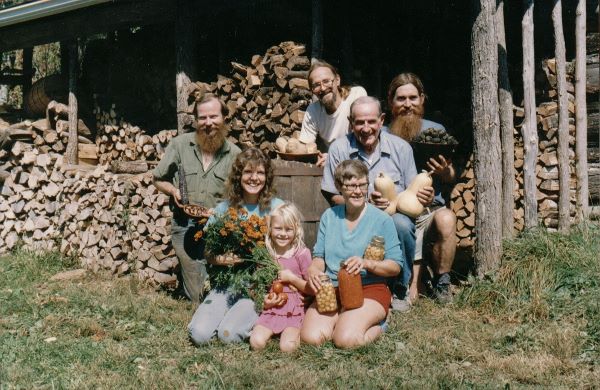
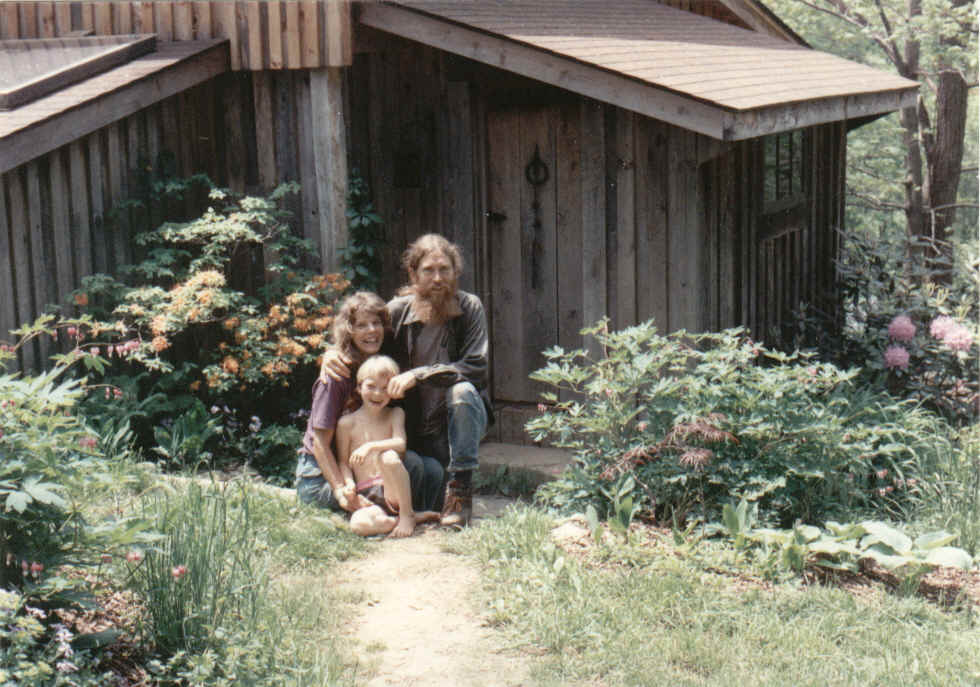
Robert & Lauren (1991)

Robert & Lauren (1991)

June 1992

[The following note was included as a preface to the Summer 1992 issue of the original Lofty Chronicles, and was intended to prepare Lauren's aunts, uncles, and grandparents for the intensity of what they were about to read. The first two months of that issue, June and July, are included here. The August entries will appear in our Summer 2003 Journal, as Part Five of the Lofty Chronicles.]

This has been quite a summer. First Joyce’s father, Joe, had a heart attack. Joyce packed a suitcase, ready to head north the moment a call came through saying she was needed. Joe made a good recovery, however, and we caught our breath. But only momentarily. The same day we learned that Joe had been released from the hospital, we got another message. Joyce’s mother had just been admitted to an Emergency Room in nearby Blacksburg-also with a heart attack.

Lilly eventually needed open-heart surgery, followed by a lengthy recuperation. She’s better now. But for a while Joyce was on the go constantly, shuttling back and forth between Blacksburg and Roanoke, where the surgery was performed.

This crisis had just started to ease off a bit when the third wave hit. In late July we learned that Adam, who has lived at Light Morning for over six years, had been fondling Lauren and her friend Myra since early Spring.

We were stunned, outraged, sickened, and bewildered. We were also plunged into a maelstrom of simultaneous and often competing needs–supporting the girls, supporting Adam, processing our own emotions and those of our friends and neighbors, not to mention becoming involved with attorneys, therapists, and the local social services and judicial systems.

In the pages that follow, I’ve tried to include at least some of this processing, along with the more normal vignettes of Lofty’s daily life. I’ve also added a few of my other journal entries, which, while not directly related to Lofty, seem to foreshadow what was about to occur. They show, as well, how certain “muscles” that we have been exercising for a number of years were suddenly called into use.

Reviewing the journal selections included here, I imagine that what’s been left out will likely cause some distortions and confusion. But this issue is over-long already, so we’re sending it off to you as is, with our love.

* * *

The Fawn (Monday, 1 June 1992) This morning, while Mary and I are watching a surveying crew work their way down the stream which marks our shared boundary line, I notice a new-born fawn curled up next to a fallen log. Mary and the lead surveyor had already walked past it. It is exquisitely camouflaged, the mottled brown and white blending into the fallen leaves. And it’s perfectly still. Only the fawn’s eyes are moving, ever so slightly, following us.

After watching it for a few moments, Mary leaves to get Sage and I go looking for Lauren. When Lauren and I return, Mary and Sage are already there. The fawn has risen up on wobbly legs and is standing behind the log. Then it runs down the hill and lies down again, this time by the edge of the stream.

The rest of the surveying crew are working along the stream bed, heading directly toward the fawn, which is partially in the water. Not seeing anything better to do, I go down to the stream and pick up the fawn. It’s about the size of a small goat. It sounds like one, too. In a surprisingly loud voice, it begins bleating, “Ma-a-a-a, m-a-a-a-a.”

Lauren and Sage (as well as Mary and I) melt with wonder at this little creature. We each say a brief hello and goodbye, then I carry it further up the hillside, where it will be out of the way of the surveyors, and set it down. It runs on up the slope on teetery legs, bleating as it goes. Then it disappears behind some shrubs. Listening to its plaintive call, we know that its mother won’t have any trouble finding it again.

Gatto’s Revolutionary Perspective (Tuesday, 2 June 1992) I guess you could call it a relapse. Or the need for further recuperation from the effects of my birthday sickness. Or, and this gets closer to home, the need for more complete assimilation.

It feels like something is lodged in my stomach, tormenting me, not letting me get comfortable in any position. Even now, several days later, my energy level and digestive system aren’t quite right. That’s why I’ve stopped eating and have decided to stay in bed all day. Recuperation. Assimilation.

On a non-literal, “dream” level, I’m still trying to digest that John Taylor Gatto tape on compulsory public schooling, which elicited such a gale of tears when I first listened to it on the morning of my birthday.

Joyce comes in to briefly keep me company. She, too, is sensing that the impact of Gatto goes far beyond the question of Lofty’s home schooling.

“It’s not just about changing a piece of the educational puzzle,” she says. “It’s like putting on a new pair of glasses. Everything you see, you see differently—the whole accepted definition of what life’s all about. It’s not about doing everything right. It frees me up not to do what other people want me to. It makes me bold.”

We’re Both Doctors (Tuesday, 2 June 1992) Lofty and Eli are down at the house this morning. I overhear a brief snatch of their conversation.

“Let’s play doctor,” Eli suggests.

I chuckle to myself, wondering if that still means what it used to mean when I was a kid. “O.K.” says Lofty. “We’ll both be doctors and there’s been an accident somewhere.”

“Yeah,” replies Eli, not taking the cue. “I’ll be the doctor and you be the nurse.”

“No,” says Lofty, with mild emphasis, “We’re both doctors.”

“Oh. Well, O.K.”

And the game gets under way.

The Intervention Threshold (Tuesday, 2 June 1992) When kids get into trouble, how soon should the adults intervene? The intervention threshold fluctuates from parent to parent, of course, and from situation to situation. Personally, I tend to favor a rather high threshold. Problems are such a precious commodity. We need to be careful, as adults, not to rob our children of their problems.

The Trickery of the Spirit (Tuesday, 2 June 1992) It occurs to me this afternoon that I’ve been so good about taking care of my lower back, doing the daily exercises so religiously, that a bad back can no longer be reliably used as a way of immobilizing me for several days in order to “force” me to assimilate something I’ve been too busy to attend to. I’m inwardly amused that the Spirit has had to resort to yet another trick, such as my birthday illness, in order to effect the same result.

“The Spirit must have quite a number of such devices,” I think to myself.

“You can’t begin to imagine,” replies an amused inward voice, “how many tricks the Spirit has up Its sleeve.”

The Evil Corpse in the Package (Friday, 12 June 1992) Lofty awakens with a powerful dream this morning. In the dream, she’s standing by our mailbox with Lilly. A large package has been delivered. Lofty is sure that it will contain “a small, evil corpse.”

When they open it, however, they find instead a number of gift-wrapped presents, as though for a birthday or for Christmas. Lofty is greatly surprised and relieved.

[A note added toward the end of August: This is an amazing dream. I remember being puzzled and bothered by it, and asked Lofty to share it with me several times. The feeling-tone of the dream just didn't seem to match the circumstances of her life, as far as I was then aware of them. We now know more. And my already deep respect for dreams gets another strong boost.]

Where Do You Sell Your Calligraphy? (Sunday, 14 June 1992) Joyce and I are packaging some of our calligraphy pieces today when Lofty pokes her head up the stairs.

“Where do you sell your calligraphy?”

“In stores, mostly,” Joyce replies.

“Do you sell them at the Augusta store?”

Augusta is an Appalachian traditional arts center in West Virginia. Joyce spends a week there each summer as an assistant calligraphy instructor. Last year she took Lofty along, and will again this year. There’s a small store on campus where the crafts people and musicians sell their art work and musical tapes.

Getting an affirmative nod, Lofty continues, “Do you think I could sell some of my little notebooks there?”

She’s been making pocket-sized notebooks lately, with brightly colored covers.

“No, I don’t think so. Only the instructors can sell things in the store.”

“Oh.”

Then, overcoming her initial disappointment, she brainstorms her way into a decision to make enough notebooks so that she can give one to each of the kids in the Augusta children’s program, which she’ll be participating in.

“Maybe our teacher can use them as part of an art project for the class,” she says, and happily goes back downstairs to continue working on them.

Later she shows us her collection–a rainbow array of small notebooks, neatly displayed in a small box. She says we can each have one.

A Spelling Lesson (Sunday, 14 June 1992) I’m fixing a big salad for supper. Lauren comes in from the porch with paper and pencil in hand.

“How do you spell radical?” she asks.

I spell it out. She copies it onto her paper, obviously making a caption for some drawing.

“What in the world does she want that word for?” I wonder, trying to imagine how she’s using it. It’s not until her next question, however, that the usage became clear.

“How do you spell dude?”

I smile and give her the letters. “Radical, dude!” is part of the Ninja Turtle lingo. So I stash the phrase away in a mental file, to be brought out again at some opportune moment.

I envision being in the garden with her. She’s pulling up one of her sweet-tasting carrots. And I casually say, “That’s radical, dude!”

Then I share a little secret with her: that the hidden meaning of radical is “root.”

This will intrigue her, the idea that words have secret meanings. She’s big into Pig Latin as a private language these days. If the timing’s right, and my touch is light, maybe the Ninja Turtles can be a doorway into the delights of etymology.

Red Ninja (by Lauren)

Red Ninja (by Lauren)

Take Me Out to the Ball Game (Tuesday, 16 June 1992) I’m in the loft this afternoon. Lauren’s singing in the living room.

“…Buy me some peanuts and cracker jacks, I don’t care if we never get back.”

Eli’s birthday is coming up. Lauren’s been invited. They’re going down to Salem to see a baseball game. The Salem Buccaneers (a farm team for, I believe, the Pittsburgh Pirates) will be playing a team from North Carolina.

It will be her first baseball game and she’s already excited. She got Joyce to teach her the lyrics to “Take Me Out to the Ball Game.” And this morning she was looking at the sports section of the paper with me, seeing what kind of record Salem has, and who the best hitters and pitchers are. Now she’s all primed to, “Root, root, root for the home team, if they don’t win it’s a shame…”

Animal Encounters (Thursday, 18 June 1992) This morning I find a weasel on the side of the driveway, probably killed by an owl or a cat. It’s only the second weasel I’ve seen in the eighteen years we’ve lived here. I take it up to show Lofty, who’s intrigued. It has a small, lithe body, bright eyes (even in death), and sharp teeth. It lies curled, life-like, in the palm of my hand.

In the afternoon, a large Cecropia moth, newly emerged from its cocoon, crawls to a porch post by the kitchen door and rests there at eye level for several hours while it finishes pumping life into its wings. We pause as we pass by, admiring its intricate beauty. When its wings have strengthened sufficiently, it flies a spiral path into the poplar tree overhead.

Later, when Joyce and Lofty are near our mailbox, they come upon a snapping turtle by the side of the road. It has crawled up out of the frog pond to lay its eggs in one of Edgar’s fields. Once again there’s an opportunity, this time from a safe distance, to examine the critter at length.

“She was ugly,” Lauren tells me.

Now and then, for a brief, shimmering moment or two, I blink away the blinders of familiarity and give thanks for this lifestyle. What a special blessing it is to be able to see other creatures going about their daily business of living and dying, independent of our ponderous human endeavors.

Soul Food (Thursday, 18 June 1992) Our personal circumstances are grist for the mill and food for the soul.

They Thought I Was a Boy (Friday, 19 June 1992) Joyce, Lauren, and I are at an outdoor concert in Blacksburg with Lilly and Sandy tonight. While the staid adults sit on the grass enjoying the music, Lauren quickly joins a group of kids playing tag among the trees and bushes near by. Not until the concert is over does she show up, tired and happy.

“They thought I was a boy,” she announces with a smile, referring to her new friends.

“And why do you want to be a boy?” Sandy asks.

“Because girls can’t take off their shirts.”

Ah, yes. Slowly the memory comes into focus. It’s been several years now. A small town in North Carolina. Joyce and Lauren are there visiting family. They’ve gone to a neighborhood playground. It’s stinking hot. Lauren, who’s five, has taken off her shirt and is running around in a skirt.

On the swings is a group of girls, 8 or 9 years old, that Lauren’s trying to befriend. They are shunning her tentative approaches, however, and are making fun of her because she’s shirtless. Having grown up with the freedom to run around naked in the hot summer months, Lauren can’t figure out what’s troubling these girls. She’s confused, and hurt by their rejection.

Finally, a self-appointed committee of several girls comes over to Joyce.

“Why do you let her go around without a top on?” one of them asks in an accusatory tone.

Joyce is impressed by their willingness to explore the question and to confront someone who is clearly, through their eyes, being negligent in her role as a mother.

So Joyce explains our lifestyle to the girls, who are remarkably receptive.

Then she hikes Lauren’s long skirt up above her non-existent breasts. This conciliatory gesture, along with Joyce’s explanation, seems to satisfy the girls. They take Lauren off to the swings with them and integrate her into their circle of friends.

Recalling this incident, I sense the intricate tapestry of factors, both personal and cultural, that have coalesced into Lauren wanting to be called “Lofty,” and her pleasure at having been taken for a boy earlier this evening.

[Looking back at this June journal entry from the vantage point of August, I am searingly aware of another, and even more compelling reason for Lauren needing to take refuge in being a boy. And my heart brims with sadness and anger.]

The Deer Attacking the Dog (Tuesday, 23 June 1992) Joyce glances out the large west window of our house to see a deer attacking a dog. The deer is chasing it, nipping it, rearing up and pawing at it. Recovering from our astonishment, we realize that the dog must be after the deer’s fawn.

I dash outside to drive the dog away. The deer bounds off, but the dog keeps trying to get past me, to get at the fawn. Then the deer returns, walks slowly toward us, waits for the dog to see her, and then leads him off on a wild goose chase.

I’ve watched a quail fake a broken wing in order to lure me away from her nest. But I’ve never heard of a deer doing something similar. What an extraordinary demonstration of the maternal instinct.

Going Into Her Closet (Wednesday, 24 June 1992) Lauren and I are down at the house. She’s in her room; I’m in the living room.

“You want to see my meditation area?” she asks.

I’m a bit startled. You don’t hear the word “meditation” float around here too much. We find other words for it, like “sitting,” and try to allow Lauren’s germinal interest in this facet of our lifestyle to ripen naturally. So I wonder what she’s up to.

Walking over to her room and peering in, I see that she’s sitting in what was formerly her closet. The shelves are still there, with stacks of folded shirts and pants. But all her hanging clothes have been moved elsewhere, and she’s sitting quietly in the newly created space.

“You like it?” she asks.

I nod.

It occurs to me to pass on what Jesus had to say about the proper place for prayer: “When thou prayest, enter into thy closet, and when thou hast shut thy door, pray to thy Father which is in secret.”

I manage to keep the door of my own mouth shut, however, and leave her to her solitude.

Mama Hen (Friday, 27 June 1992) I’m scything tall grass by the edge of the driveway, out by the mailboxes. The sweep of the blade occasionally uncovers small clusters of wild strawberries. Now and then I bend down, gather a handful, and eat them.

One of the children from the Hollow House is sitting at the top of his driveway, watching me intently. The scything seems to fascinate him, as do my strawberry snacks. After a while he wanders over. I offer him a few berries, which he shyly accepts. Soon he’s following close behind, scanning the newly mown swath for more.

He’s joined by a brother and a sister. Then Lofty and Becky, who are watching the horses, get curious and come over, too. That makes five children trailing along in my wake, finding just enough berries to keep them all searching.

Suddenly I laugh aloud. Just yesterday I’d seen one of Stanley’s mama hens scratching up grubs for her clutch of biddies, who were hustling along close at her heels, pecking at whatever she turned over. And here I now am, a mama hen myself, uncovering treats for a brood of hungry youngsters.

Horsepower (Saturday, 28 June 1992) Becky and Alysia’s family just bought a new Toyota pickup. Very powerful. 160 horsepower. And very expensive. A puzzling choice of vehicles for a large family, it seems, looked at from the outside. But when Willie says it can pull a two-horse trailer, the missing piece of the puzzle falls into place.

Alysia, who’s been giving Lofty riding lessons, and her sister Becky, will be wanting to compete in the horse shows that are an integral part of the Virginia tradition. And you obviously have to be able to transport the horses and their riders to the shows. A small compact car, or even a station wagon, can’t pull that kind of a load.

So now Willie commutes to his new job as postmaster in a Toyota pickup. And the girls are preparing to compete in the horse shows. And I’m left to marvel at modern technology, which harnesses up one hundred and sixty horses in order to pull two.

This entry is part 8 of 20 in the series The Lofty Chronicles

Part Four: A Traumatic Revelation
(continued)

Lauren at the treadle sewing machine

Lauren at the treadle sewing machine

July 1992

Expectancy (Monday, 6 July 1992) It’s close to 10:30. Joyce and I are brushing our teeth and getting ready for story and bed. Lauren comes downstairs from the loft to join us. She’s been working on secret codes for the past several hours—first typing the master code on the computer (and thereby practicing how to save, view, and print documents in WordPerfect); then using one of Joyce’s calligraphy pens to write notes to two friends (“How do you spell ’secret’? How do you spell ‘brother’?”); and finally folding everything up into two bulky packets and stapling them into home-made envelopes.

She brings the envelopes down with her when she comes to brush her teeth. Eli is visiting in the morning and she wants to be ready.

“I can’t wait ’til tomorrow,” she exudes.

“It’s nice that you’re so excited about your life,” I reply.

“What do you mean?”

“Well,” says Joyce, “Not everyone looks forward to their tomorrows as eagerly as you do.”

“I’m almost always looking forward to tomorrow,” Lofty replies, “except when I have to go to the doctor or the dentist.”

Then, after a pause, “But if someone were going to the doctor to have a baby, I bet they’d be looking forward to it.”

“That’s for sure!” Joyce says with a grin.

A Learned Tolerance for Diversity (Monday, 6 July 1992) It’s sobering to observe the endless daily reminders of how un-accepting we are of one another. I recall the phrase that was singing through my mind for days after the striking dream about the Tall Ones: the rightness of what is.

It would almost seem, however, as though we humans possess a genetic intolerance for diversity. Our dislike for someone saying or doing or thinking something other than what we normally say or do or think is deeply embedded.

We’re un-accepting of others because we’re unable to accept ourselves. And this is where a learned tolerance for diversity must begin. The roots of our personal insecurity are what need attention. Otherwise we just end up squeezing the balloon.

Lofty’s Intuitions (Tuesday, 7 July 1992) Lauren and I are taking her friend, Eli, home this afternoon. He’s been over for the day. Going out, we pass a car coming in. Lauren immediately says, “I bet that’s our guests.”

We’re expecting a couple from Virginia Beach to show up at Light Morning during the next few days. We don’t know them, don’t know exactly when they’ll be arriving, and certainly don’t know what their car looks like. And we’ve already passed several other unfamiliar cars on the road.

Lauren, however, sounds quite certain that this particular car contains our guests.

“We can test your intuition when we get home,” I say. “We’ll see if that car’s in our parking lot.”

After dropping Eli off and turning around, we pass Doro heading out.

“There’s Doro,” exclaims Lauren.

Then, as though having just seen something, she adds, “She’s going out to Smith’s Store to get treats to bring to music night tonight.”

“Could be,” I reply, thinking it rather unlikely.

Doro rarely comes to music night.

“That will give you another chance to test your intuition. We’ll ask her, if she shows up tonight.”

The rest of the way home we discuss intuition—how we sometimes know something without knowing how we know it; the difference between knowing and guessing; and why our intuitions are sometimes right and sometimes wrong.

To Lauren’s surprise, the car that we had passed on our way out is not in our parking lot when we get home. But it is pulled up next to the community shelter. And it does belong to our guests.

And sure enough, Doro arrives after supper for music night. She mentions that she’d seen us as she was driving to the store to pick up some potato chips for tonight.

Lofty smiles at me.

“Nice going,” I say. “Two for two.”

The Road to Heaven (Wednesday, 8 July 1992) The road to hell, the saying goes, is paved with good intentions. One might also say that the road to heaven is paved with good intent. The highway to heightened awareness, in other words, becomes passable only as we acknowledge the good intent that is at the core of all people, all things, all circumstances.

The more we’re able to see the presence of All That Is within others, the easier it becomes to recognize It within ourselves. And it the more we experience It within ourselves, the more we start seeing It in the people and circumstances around us.

It reminds me of the lyrics for a little song I wrote a number of years ago.

If you could see yourself smiling
Reflected in the face of each thing
Then there’d be nothing that could ever bring
Back your fears.

And if you could hear yourself singing
In the heart of each person that you meet
Then every sound would be sweet
To your ears.

[How do we know what we know before we know it? These memories and insights, which arose seemingly unbidden in my mind, were just about to be put to the test.]

Lofty’s Letter (Thursday, 9 July 1992) Joyce has been away most of the past two weeks. Her mother, Lilly, has been hospitalized in Blacksburg with a heart attack. Joyce has been helping out, sometimes taking Lauren with her, mostly leaving her here with me.

Joyce and Lauren have been missing each other. The feelings are complex, since the mother-daughter energy between Joyce and Lilly, and especially their anxiety over the heart attack, will unavoidably rebound into the other mother-daughter relationship. So a lot of confusing transference is probably going on right now.

This afternoon, while I’m cat-napping, Lauren writes a letter to her absent mother. When I awake, she shows it to me.

“I am coming withe you this time,” it says. “And dad shud com to. Love from Lofty. P.S. Navr go awae for that log agen. Love from Lofty.”

I tell her it’s a lovely letter.

“I didn’t want to wait to ask you about the spelling,” she says. “So I just went ahead. I think Mom will get the meaning.”

“I’m sure she will. Don’t worry about the spelling. That stuff comes later. The meaning’s the important thing. Mom will love your letter.”

Lofty goes out to her swing. I sit for a moment, brooding on what a perfect example of natural learning this letter is. We haven’t been urging her to read or write, trusting that her innate desire will emerge in due course, and believing that learning to read and write is like learning to walk and talk. We don’t have to artificially create the desire. It’s already there. We simply have to lend a helping hand when it’s asked for.

Lauren had some feelings that she wanted to share, and had enough tools to get that feeling across. In doing so, she intuitively realized that meaning is more important than spelling. Later on she’ll learn that better language provides a greater range of expression. For now, though, her tools were perfectly adequate for the task at hand.

What’s more, she wrote the letter entirely on her own. “I do it myself!” was Lauren’s constant mantra as a toddler, especially when some well-meaning but meddling adult offers more help than had been asked for. I’ve heard the same phrase repeated endlessly by other youngsters.

Perhaps adults are slow to get the point. We seem to think that children are inherently different from us; that they thrive on unsolicited assistance and advice. Someone once offered that if the Golden Rule is, “Do unto others as you would have others do unto you” (a rule big people have great difficulty in applying to little people), then the Iron Rule should be, “Never do for others what they can do for themselves.”

The timing of Lofty’s letter-writing was impeccable. We both knew that I’d be highly unlikely to correct her spelling (and ruin her letter) while I was asleep. So she seized the brief moment of my nap-time to “do it herself.”

Robert, Lauren, and Joyce at Transdyne

Robert, Lauren, and Joyce at Transdyne

Lofty’s First Fair (Saturday, 11 July 1992) Lofty and I are at the Salem Fair with Wes, Shara, and Rosie. The temperature’s in the mid 90s. But that doesn’t deter the girls. They’re pumped!

Especially Lofty. This is her first fair. She’s been listening to the audio tapes of Charlotte’s Web, by E.B. White. The climax of that story is set at a county fairground. While this isn’t exactly a county fair—there are no livestock exhibits or canned goods or blue ribbons—it’s close enough. There are candied apples, cotton candy, and lemonade. And lots of rides.

The first one we happen upon turns out to be the most gut-wrenching of the day. I forget its name. There’s a tall central column, maybe 50 or 60 feet high. A number of long chains hang down from it, each one attached to a small, one-person, gondola-like car. The riders buckle into the cars, the column begins to rotate and pick up speed, until the cars and their occupants are whirling far overhead at high velocity, the chains nearly parallel to the ground.

A ride is in progress as we approach. It’s impressive! Lofty eyes it cautiously. Rose, on the other hand, can’t wait. Wes had let her ride it the other day.

Shara and I look at each other, thinking, “Are we really going to let our kids go up in that thing?”

But Rosie’s enthusiasm, and the expectations of the day, overcome both Lofty’s caution and our parental protectiveness.

So when the blaring music dies down, and the chains and cars come to a standstill, and the riders stagger out, the girls clamber onto the platform and take their seats. I call out to Lauren to be sure to hold tight. She nods and manages a weak smile. Then the music starts up again and the central column begins to turn.

Slowly at first, and then with increasing speed, the cars swing out in a widening gyre. Lofty’s face, as her car spins into view, is frozen in dismay.

“I’ve changed my mind, Dad,” her face says. “I don’t want to be here. Please tell the man, right now, to stop this thing so I can get off.”

But she knows, and I know, that there’s no stopping and no getting off. It calls to mind the time she contracted whooping cough. Once under way, there was no turning back. Surrendering to the full experience was our only option.

So I wave and smile encouragement each time her car whirls by, she clinging desperately to the chains, and the ride seems to go on and on, forever.

Finally the music ends and the cars coast to a stop. The girls get out and come over to where Shara and I are standing. Lofty looks at me.

“I am never, ever going up in one of those things again!” she announces passionately.

Then she holds out her hands, palms up. The marks of the chains are imprinted on her bone-white flesh.

I hoist her up, give her a big hug and a kiss. Then she and Rosie run off to decide on their next ride. Nothing that follows, however, not even the roller coaster or the 100-foot Ferris wheel, is much of a problem. That first ride put everything else into perspective.

He Is You (Wednesday, 15 July 1992) Adam and Marlene and I are squabbling about the adequacy of our water supply. Nothing serious. While we’re debating the issue, Lofty’s over at the desk, drawing.

Later, after everyone’s had their say and gone their way, Lofty shows me her drawing. At the top of the page are the words, “He is you, and you are him.”

Below the words is a picture of two smiling faces. The one on the right has a cartoon rendition of what it’s thinking. It says, “I am him.”

The one on the left is twice as big as the first one. Its thought is likewise labeled. “I am him, too.”

“Tell me about these guys,” I say.

“They’re two robots. But they’re really only one. The big one made the little one. He was lonely or something. So he made the little one. But they both know they’re the same.”

Patience and Desire (Saturday, 25 July 1992) We are striving to assimilate our circumstances. To re-connect the inner and the outer worlds. To re-integrate what’s within us and around us. To wake up. Given sufficient patience and desire, this communion can occur. The mirror does come clear.

But it takes both patience and desire. If we’re impatient, we never allow the murky waters of the seemingly external world to clarify and grow still. And if our desire is weak, if the striving for assimilation and re-connection isn’t impeccable, then by the time the mirror does clear, we’ve forgotten that what we’re seeing in the waters of our personal circumstances is our reflection. We’re back asleep again.

Lofty’s Week at Augusta (Monday, 27 July 1992) Joyce and Lauren have just returned from their week at Augusta Heritage Center. The calligraphy class that Joyce helped teach went well. They had a number of repeat students, which is good feedback for the instructors.

Lofty had several firsts. She attended her first Catholic Mass, and liked the priest, who, upon meeting her, held out his hand and said, “Give me five!” But she was disappointed that the kneeling-benches were no longer in use. The congregation apparently stands to pray these days.

She also practiced stone carving for the first time, which, in her excitement at telling me about it, she calls “stone starving.” They use a soft stone and a sharp scalpel. They normally don’t let kids under 12 practice this art. But Lofty did well, only jabbing herself once.

And last but not least, she had her first brush (or should I say blush?) with romance. She was in a class with nine other girls and one boy. The boy, an eleven-year-old from California, took an instant shine to Lofty. She was suitably impressed with Nat’s attentiveness, but didn’t quite understand it. To her, he was just another friend.

Nat, on the other hand, was rather more smitten. On the last day of the week, Joyce saw him sitting on some steps with his head in his hands.

“Hard to leave, isn’t it?” Joyce asked.

He nodded glumly.

“You coming back next year?” she continued.

Another nod.

“We’ll probably see you then,” she said, and started to walk away.

Finally, Nat seemed to tumble to whose mother he’d been talking to.

His head slowly lifted out of his hands.

“Are you coming back next year?” he asked.

Joyce smiled and nodded.

“Well,” he said, his mood visibly brighter, “I guess I will be seeing you then.”

[In retrospect, this is one more instance of the "synchronicities" that have accompanied the unfolding of events this summer. Everything is so inter-connected! It was the day after Lofty returned from Augusta, and her first tentative "boyfriend" experience, that she told her friend Claire about what had been going on with Adam. Myra, independently, and on the same day(!), told her older sister.

So everything secret came tumbling out, and the package with the "small, evil corpse," the arrival of which Lofty had been dreading in her dream from the morning of June 12th, was finally delivered into our unsuspecting (our consciously unsuspecting) hands.

In time, and with a good strong dose of the desire and patience alluded to in the July 25th journal entry, the opened package would indeed prove to contain presents, just as Lofty's dream had foretold. First, however, would come fire.]

Alice’s Revelation (Wednesday, 29 July 1992) Alice, Myra’s mom, comes down to our house with Adam at dusk this evening, just as I am finishing work on our new wood shed. She says she has something she wants to share with Joyce and me. Adam looks extremely sober.

We sit down on the back porch, in the dusky twilight, and Alice tells us that she has just learned that Adam had been fondling Lofty and Myra, and that the fondling had been going on for several months.

Joyce and I are stunned. My first, impulsive reaction is to do an inner “take” on Lofty. The immediate impression is that, while there are clearly going to be problems, she’s basically O.K. She’s going to need reassurances that touching and hugging are still good things; and help with her guilt for not having told us about it sooner, as well as her guilt for having told at all, when it may well send Adam to prison.

Further down the road, and still more pernicious, she may have to work with a tendency to equate her sexuality with something illicit and dangerous. This awareness fuels our cascading anger and deepens our grief for her sudden and shocking loss of innocence.

But it’s tempered by the gut sense that she’s a strong, resilient kid, both loving and loved, and that as bad as it is, it could have been much worse.

Then, surprisingly, my concern shifts to Adam. I know what others have gone through when confronted with sexual abuse charges. He is going to be facing some very painful fires. And while part of me feels he deserves the full social and judicial consequences of his actions, another part remembers my own horrific fire experience the week after Lauren was born. And this spontaneous memory kindles a strange empathy for someone whose life is about to go up in flames.

Finally, a realization dawns that this is a “moment of truth,” not only for Adam, but for all of us—for those now involved, and for so many others who soon will be. I know, as clearly as I have ever known anything in my life, that we are about to be tested.

A Long Talk With Adam (Friday, 31 July 1992) After giving Adam a day or two to “stabilize” somewhat, I go up to the community shelter to look for him this evening. The lights are on, so I know that he’s around, but the shelter is empty.

I settle down to wait, recollecting my fire experience and feeling increasingly deep parallels between it and Adam’s situation. Then, from the direction of the parking lot, comes the loud crack of a gun shot.

I stand up, feeling suddenly queasy, and walk in that direction. When I arrive at the steps of Ron and Marlene’s house, however, I hear Adam and Ron talking. The shot has been our neighbor’s attempt to keep the critters away from his crops.

Adam and I return to the porch and have a long talk. He’s in obvious denial during the first part of our conversation, believing that the crisis, while very serious, is containable. Then, as I convey my own understanding that the news of what has been going on between him and the girls will inevitably spread through the community, neighborhood, and county, and will, quite likely, end up in the courts, Adam begins to grasp the implications of what he has immersed himself in.

I suggest he’s going to find himself in desperate need of a friend, but that before I can even consider being such a friend, I have to unburden myself of the seething anger and sense of betrayal that his actions have aroused in me. Which I proceed to do—pointedly, and at length, and with no little heat.

Then, when the flood tide of my anger has run its course, I sketch for him a brief outline of my fire experience, in the belief that what he is about to go through may well follow that archetypal pattern.

In response, he draws the full story out of me, in a way that no one has since I passed through that terrifying hell eight years ago. I marvel at the deep rightness of my strong intuition, in the immediate aftermath of that great burning, that what I had just gone through would one day come to be seen as a great blessing.

For many other people, I had suddenly realized, even as the embers were still smoldering, will one day have their own versions of this archetypal trauma. And without having passed through the flames myself, I would have neither the understanding nor the empathy to be there for them when they needed it.

“How profoundly true that insight was,” I keep thinking to myself, as Adam starts to process his tumultuous feelings of guilt, fear, and self-loathing. While unable and unwilling to downplay the intensity of what he’s about to go through, I am able to hold out the promise of light at the far end of his looming tunnel of darkness.

And he can feel enough inner resonance to my words to allow him to find a few lucid intervals of peace in the midst of his raging firestorms of shame and anxiety.

This entry is part 9 of 20 in the series The Lofty Chronicles

Part Five: Trial By Fire

Lauren's artwork: Creature with heart

Lauren's artwork: Creature with heart

August 1992

An Intense Paradox (Sunday, 2 August 1992) I find myself lost in wonder at the intense paradox between Adam’s utter stupidity, at a conscious level, for believing that his reprehensible behavior with the girls would remain undetected; and his deep wisdom, at a subconscious level, for creating a situation that holds so much perilous promise for his eventual healing and release. Both qualities, the outer stupidity and the inner wisdom, stand in brilliant relief and dance together flawlessly.

Strong Medicine (Sunday, 2 August 1992) As the events generated by the disclosure of Adam’s molestation unfold, I’m struck by the relevance of the Christian teachings. From the Golden Rule (doing unto others as we would have them do unto us), to the warning about letting those without sin cast the first stone, to Jesus having taken his ministry to the outcasts of society, I’m finding our blood-myth to be strong medicine indeed.

The Summer Olympics (Saturday, 8 August 1992) How appropriate that the summer Olympics are under way. What we’ve been going through recently feels like a qualifying meet for the inner Olympics. It’s as though Light Morning has spent most of the past two decades training for moments just like these.

Fertile Soil (Tuesday, 11 August 1992) Adam stunned us last night, reporting that his lawyer is preparing him for the possibility of a possible 40-year prison term. “Twenty years,” the attorney stated, ” would be considered a victory.”

Pondering this draconian sentence during my morning walk, I inwardly hear the phrase, “welcome to the fertile soil of the mass mind,” and realize just how bankrupt our current culture is. How receptive its rich and loamy earth must be to new seeds.

Striving for Openness (Tuesday, 11 August 1992) Open heart, open mind. This has been my mantra of late. Keeping open the infinite array of probabilities. Releasing pre-conditions and pre-conceptions. Acknowledging the rightness of what is. The ripeness of what wants to be. These metaphysical abstractions have come alive lately, serving as a challenge, a comfort, and a refuge.

The Cooperative Universe (Tuesday, 11 August 1992) Another comfort has been the way in which so-called “coincidences” have multiplied over the past few days. I can’t begin to list them all. Even attempting to do so feels like taking a live butterfly and mounting it for display.

They range from Myra’s dad “happening” to be friends with the attorney to whom we had been independently referred, and having her home phone number, which we needed but had been unable to get; to our appointment with this attorney being on the same day and at the same time as Adam’s appointment with his attorney; to the exquisite timing of returning to our parking lot late in the day, just as Adam was pulling in, deeply shaken (having just learned of the potential 20- to 40-year prison term) and in need of support.

The T-shirt that Adam gave Joyce last Christmas reads, “Synchronicity: God’s way of remaining anonymous.” I see it more as God’s way of leaving a calling card. Especially when everything spirals out of hand, these tokens of a cooperative universe remind us of a bigger picture and a wiser design. They put us back in touch with the essence of ourselves–with the gifted Choreographer who shapes all the anxious and confusing moments of our days into grace.

Choosing Who to Feed (Wednesday, 12 August 1992) Joyce is wrestling with how she’s been channeling her energy lately. She has concerns about a potential, although unlikely investigation by Social Services into our lifestyle and a possible judgment about our fitness as parents. She’s also anxious about Adam being shipped down the river by the judicial system.

She’s feeling strong tendencies flowing in both directions–feeding her faith and feeding her fear. I’m reminded of one of the striking passages from the Castaneda teachings:

“It all depends upon what one emphasizes. Either we make ourselves miserable, or we make ourselves strong. The amount of work is the same.”

History (Wednesday, 12 August 1992) “I don’t like history,” Lofty announces at lunch today, as we’re finishing up our soup and munching on some chips. The comment catches us by surprise, as Lauren has always shown a strong interest in historical biographies.

“History is stories,” says Joyce. “Like the story we’re reading now about Abbie Burgess, who helped tend the lighthouse on Matinicus Rock on the coast of Maine over a hundred years ago.”

“That’s different,” replies Lofty. “I mean stuff about George Washington and all that.”

“How about George Washington Carver? You liked those stories.”

“That’s different, too.”

A pause.

“Well, anyway,” she concludes with a grin, picking up her bowl, “these chips are about to be history.”

We laugh and let it drop, feeling good that she’s in a mood for jokes.

Later, however, while mulling over her professed dislike of history, it occurs to me that it may be her more recent (and more personal) history that she’s having trouble with. In any case, the laughter is healthy.

Three Wishes (Thursday, 13 August 1992) Joyce and I take Lofty to a therapist today. The visit is mostly precautionary. We feel she’s doing well with all this, but want to check out our impressions with someone who has had training and experience in this field and who comes highly recommended. The visit will also be helpful in the event that Social Services gets involved. The therapist first speaks with us together, then spends quite a while with Lauren. Her conclusion is that Lauren is handling the situation well and that she hasn’t picked up any significant inner disturbances. Basically, she’s very reassuring.

She tells us, for example, that she’d given Lauren a “magic wand” and asked what her three wishes were. Lauren responded to this often revealing diagnostic device by wishing for a horse, a sketch pad, and some drawing pencils.

Lauren later tells us that the therapist had urged her to acknowledge having “mixed feelings” about Adam.

“She wanted me to say that I’m angry at him. But I wouldn’t do it because it’s not true.”

Her stubborn refusal to see Adam as someone other than a friend puzzled the therapist. She thought at first that Lauren was repressing her anger. She later became convinced, however, that Lauren’s feelings were genuine. She told us to keep an eye out for delayed reactions surfacing later, but she didn’t feel this was likely. Nor did she think there was a need for further sessions.

Lauren's Artwork: Plane With Contrails

Lauren's Artwork: Plane With Contrails

Crisis Update (Friday, 14 August 1992) Social Services has decided not to get involved in this case, so we’re breathing a bit easier. They’ve turned everything over to the Commonwealth Attorney, who sent a detective out today to interview Lauren. The detective was very sensitive and gentle, so it wasn’t nearly as traumatic as our fears might have anticipated.

I sent a letter to the Commonwealth Attorney (which I’ll include below), informing him that the parents of the two girls do not want to press charges, and explaining that our preference is for Adam to receive immediate and thorough professional treatment rather than punishment.

Our lawyer, meanwhile, has been conveying the same to the Commonwealth Attorney and she tells us that, “He is certainly hearing us.”

The current likeliest scenario is for some lesser charges to be filed, in order to enable the court to have leverage over Adam. They want to be able to mandate and monitor his therapy. Some limited jail time may or may not be involved.

Adam, meanwhile, has left Light Morning. He is taking care of loose ends and has an appointment on Monday with someone in Washington, D.C. who is both a lawyer and a psychologist and who specializes is these kinds of problems. My father learned of him through a friend and fellow law professor and passed his name on to Adam as someone who might be well-qualified to offer the appropriate help.

A Letter to the Commonwealth Attorney (Friday, 14 August 1992) Here is the letter that I wrote to the Commonwealth Attorney who is heading the investigation of Adam’s sexual abuse of the two girls.

Dear ________,

This letter follows up the brief phone conversation we had yesterday, during which you encouraged me to send you any thoughts and feelings that we have concerning the report that was made to Social Services on Monday, and your current investigation.

I’m sure you can understand the depth and complexity of our feelings. Adam was and is a friend–someone we have known, lived with, and worked with for over six years. That is what makes the activities he engaged in with our daughters so incomprehensible and so difficult to come to terms with.

I have no desire to minimize the harmful effects of those activities upon our children’s lives, both now and in the future. As a parent of one of the girls, and having listened to my daughter’s graphic description of what occurred, I have experienced many strong emotions lately–disbelief, shock, anger, betrayal, and grief. I have also been deeply disturbed and bewildered by the power of a compulsion strong enough to lure Adam into doing something so unthinkably insensitive and stupid. A compulsion that over-rode not only his decency, but also his common sense.

At the same time, and here I speak for both sets of parents and for both children, we are not interested in punishment or retribution. What we do want is quite simple–we want our children protected from further harm; and we want Adam to receive the best possible therapeutic treatment and support.

It is far better that he receive the therapy he so obviously needs, and then return to a place where people know both him and his problem, than that he be exposed to a prison system which holds little if any hope for effective treatment, only to be later released from that system into a strange and unsuspecting community, with his problems not only intact but quite likely aggravated.

Putting him “out of circulation” may address our need to protect our children from immediate further harm. But it won’t solve anything. All it will do is push our problem down the road–onto another neighborhood, another set of parents and children, another round of anguish and retribution.

Somewhere this terrible cycle of child abuse, of abused children growing up to abuse other children, has to stop. Somewhere we have to find the wisdom and the compassion to see that the needs of the victim and the needs of the abuser, far from being incompatible, are actually the same.

My daughter needs safety; Adam needs healing. What better way to protect my child, and the children of other parents I don’t even know, than to do everything possible to see that Adam receives immediate and effective professional treatment.

I realize that the statistics indicate that a full recovery from this type of compulsion can by no means be guaranteed. Yet the specifics of this case offer hope. Adam, for example, has been a member of our extended family for over six years. Yet it was not until very recently, under conditions of extreme stress, that his reprehensible behavior occurred.

This behavior, as far as we have been able to determine, was non-coercive. The girls were not threatened, nor were they told to remain silent. And while she now understands that his activities with her were highly inappropriate, Lauren also continues to consider Adam a friend and has been very supportive of him throughout this crisis.

Nor did Adam’s behavior extend beyond his immediate family setting in such a way as to become a threat to other children in the neighborhood. Although he was not involved as a direct caretaker with either girl, Adam’s activities grew out of a long, close contact with them. There has been no indication, in other words, during the six years that he has lived here, that Adam has taken a casual or opportunistic interest in any child outside of his home environment.

Equally significant is that, when confronted with the accusations, Adam did not choose the path of denial. Instead, he acknowledged his guilt, expressed deep shame and remorse, and made profound apologies to both the children and their parents. He then immediately sought professional therapeutic help.

This full disclosure was made at a considerable cost to himself, both personally and legally. To see the abhorrence he felt for himself reflected in the eyes of his neighbors and friends was shattering. Perhaps only someone who has gone through such an experience can appreciate how devastating it can be.

He also understood that complete denial was his best protection in a courtroom. But he realized that this ran counter to the interests of the girls and their families, who could be dragged through a long, costly, and traumatic legal confrontation.

Finally, he somehow knew that overcoming denial was the essential first step along the long road to his own eventual recovery.

In closing, I must again say that none of the above is intended as an excuse for Adam’s behavior, or as a lessening of the pain which he has inflicted upon our families. That pain, in some ways, can never be erased.

Nor do I seek to protect him from the consequences of his actions. To try to do so would be both undesirable and impossible. For how else are we to learn, other than by reaping what we have sown?

What I am trying to do is to overcome my own hurt and anger enough to admit that in both his words and his actions, Adam has demonstrated what I believe to be genuine remorse for his behavior, and a sincere recognition of his need for help. I would hope that this remorse and recognition, along with the strong preference on the part of the two girls and their families that Adam receive treatment rather than punishment, might be taken into your considerations.

Thank you for your understanding and your cooperation during this very difficult time.

This entry is part 10 of 20 in the series The Lofty Chronicles

Part Five: Trial By Fire
(continued)

Lauren's artwork: Tarot collage

Lauren's artwork: Tarot collage

August 1992 (continued)

Shards (Monday, 17 August 1992) Now that I can catch my breath, I’ll log in a few of Lofty’s notes that have appeared recently. The first two were tacked to the wall of the community shelter the past several days. One of them is on a sheet torn out of a small notebook that Lofty has been carrying around with her. It reads, “One thing at a time. Please!!!!!!”

The other is a drawing of a smiling figure, with the caption, “I Can Have Fun Now!”

Still another page from her notebook has a short sentence on it— “Lofty Brown is the best.”

Then there’s the note she wrote to Myra while we were waiting in the therapist’s office the other day. “Dear Myra,” it reads. “Do you want to come over sometime? We can talk about the big Fuss. Love, Lofty.”

Sure enough, Myra came home with us that afternoon and stayed for supper. But as soon as we parked the car, the two girls headed to an empty cabin and had a long talk, all by themselves.

The Shock Absorber (Monday, 17 August 1992) Looking back over the past couple of weeks at how all of us, and in particular Lofty and Adam, have handled this crisis, I realize that a hidden shock absorber has cushioned much of its traumatic impact. This shock absorber is a core belief that has been evolving within and among us ever since we arrived at Light Morning nearly twenty years ago. It has to do with accepting personal responsibility for the circumstances of our lives.

More specifically, the belief holds that each of us co-creates our personal realities. Such ongoing creativity generally operates below the threshold of our conscious awareness. And it is essentially beneficial. In the same way that our body has an innate urge toward homeostasis and health, and will initiate extraordinary (if not always comfortable) processes to achieve these physiological ends, so does the psyche set up precisely those circumstances and conditions that are necessary to restore psychological balance and to bring about psychological health.

This premise goes completely against the grain of the standard culture’s prevailing orthodoxy. And it has far-reaching implications. For it suggests that our conditioned tendency to see things in terms of black and white, or good and bad, is both short-sighted and illusory, in that it creates and perpetuates a world of victims and villains; of scapegoats and saviors.

What it proposes, instead, is the radical view that we all dwell within a miraculously pliant and cooperative universe, in which each of us is always getting what we need, just when we need it.

This scandalously provocative hypothesis sounds far-fetched and abstract in the telling of it. Yet it soon becomes tangible, and challenging, in the living of it. And during a crisis, it serves as an admirable shock absorber.

Adam, for example, has occasionally been able to get beyond regarding himself as a loathsome victimizer of the two girls, or as the potential victim of a harsh “justice” system, and to find a different way of seeing things. From this new perspective he becomes aware of the hard, cocoon-like shell of denial that he has, for so long, been weaving around his soul. He can feel the healing relief that accompanies the shattering of this shell. And he senses, in some incomprehensible way, that both his actions and their consequences are part of a profound process of self-healing and acceptance.

With Lauren, the cushion is neither conceptual nor verbal. Instead, she sees her parents and their friends not treating her as a victim. She sees them actively processing the various flavors and stages of their emotions. And she sees that being angry at Adam and being supportive of him, or condemning what he did while loving who he is, are not necessarily incompatible. In this way she can join us, and in many ways lead us, in choosing to focus on understanding and forgiveness rather than blame and punishment.

Blowing Bubbles (Tuesday, 18 August 1992) The image that comes to mind this morning is a huge, magical soap bubble. On a dusky evening three weeks ago, just after the traumatic revelation first surfaced, a small group of the parents and children directly involved gathered on our back porch. As we quietly talked, it became clear that we were being confronted with a rending choice of how to respond to this situation. And in choosing, it was as though we blew a small, iridescent soap-bubble, which grew to enclose all of us on the porch.

Since that evening, as the story and the crisis inevitably spread to the rest of our Light Morning family, and then down the road and into the neighborhood, the bubble kept growing, too. As it encompassed more and more people, it somehow encouraged each of them, in a subtle but profound way, to make a similar choice, to respond in an equally honest and caring way.

And as the story spread still further, into the offices of lawyers and therapists and commonwealth attorneys, the bubble went with it–tingeing reactions, softening hard edges, coloring judgments.

It’s as though we have fostered the polar opposite of a lynch mob mentality. As painful and challenging as this whole experience continues to be, there have been remarkable compensations. Witnessing the soothing effects of this magical bubble, seeing how truly contagious empathy can be, has certainly been one of them.

Full Speed Ahead (Thursday, 20 August 1992) Ever since Joyce and I read John Gatto’s book, and especially since listening to his tape, our approach to home education has shifted. The Oak Meadow curriculum, which arrived on the same day as the tape, sat around for a couple of weeks. We looked at it, talked about it, slept on it. Then sent it back. The principle of child-led learning, as radical and risky as it seems, feels too deeply right to us. To all three of us.

We have had only occasional misgivings since then. Lofty’s been involved with horses and gymnastics and out-of-school-for-the-summer friends. Nothing properly curricular. And we’ve had our own crises and busyness.

Still, it has continued to feel good.

Then over the past few weeks, Lauren seems to have shifted into over-drive.

She’s constantly asking questions: “I’m writing a letter to someone. How do you spell ‘hold’?”

Or she’ll sit beside me in the evening while I’m reading a book and she’ll work out math problems on a pad of paper. Or she’ll accost Joyce, who’s cooking, and she’ll ask for help with cursive handwriting. Or she’ll prod me into helping her set up a gymnastics balance beam, or using Word Perfect on the computer, or finding some books she can take out of the library.

I know these surges come and go, but her current binge is particularly well-timed. It has strengthened our faith in the rightness of child-led learning. Not that we don’t have as many responsibilities for her “education.” In some ways we have more. But now it feels like we’re all on the same team. And instead of us pushing her, she’s pulling us.

Lauren's Artwork: Sun on Mountains

Lauren's Artwork: Sun on Mountains

Sharks (Friday, 21 August 1992) We’ll be going to the North Carolina beach with Joyce’s family again this fall. On the final night of last year’s stay, we went swimming by moonlight. The water was warm; the moon shimmering on the waves; the sea gently rolling. It felt peaceful, womb-like, soothing. Archetypal.

Today, however, Joyce reports a phone conversation that her mother just had with someone at the beach.

“She happened to mention our night-time swim,” Joyce says. “And the person’s response was that swimming at night on that beach isn’t advisable. Seems like the sharks come in to feed during the night. They’re not around during the daytime, but they come in at night. It’s apparently not safe to swim then.”

I have several immediate reactions.

The first is, “Jesus, we might have had a close call last year,” and my mind strays to various shark-attack stories I’ve read over the years.

The second reaction is more skeptical: “I wonder if that person knows what he’s talking about. I’ll have to ask around down there and see what other people say.”

This is followed by disappointment at the possible loss of our night-time swims.

Finally, and hard on the heels of my first reactions, comes a sudden sense of, “How perfect, how appropriate, that (at a dream level) our strong yearning to return to the womb, to float on the moon-softened surface of the ocean, should be counter-balanced by the threat of sharks. There they both are–the dreamy bliss and the hideous nightmare; the unsuspecting swimmer and the approaching shark–each gently cradled in the dark, rolling waters of the great Sea.”

Whatever the literal truth of the rumor turns out to be, it’s a perfect metaphor.

Clipper Ships (Saturday, 22 August 1992) Our current bedtime story is about Abbie Burgess. As a young girl in the mid-1800s, Abbie helped her father tend the lighthouse on Matinicus Rock, off the coast of Maine. Lauren’s aunt Heather found the book in Southwest Harbor this summer and sent it to Lofty. We’ve all been enjoying it.

Tonight, Abbie makes a rare visit to Rockland to visit her friend Prissy. While there, she attends the launching of a new clipper ship. Rockland, by the time of Abbie’s visit in 1855, had become one of the busiest ship-building centers on the Atlantic, and was providing many of the clipper ships for the coastal cities of Boston and Philadelphia.

Here I pause in my reading of the story and remind Lofty that one of her many-great-grandfathers, Thomas Cope, had a big fleet of clipper ships sailing out of Philadelphia in the 1850s.

“Probably,” I say, “some of his ships were built in Rockland, at the very time that Abbie was tending the lights on Matinicus Rock.”

Lofty enjoys the connection.

“What’s more,” I go on, “Thomas Cope made a lot of money from his clipper ships. And when Thomas Cope died, that money passed down through his family to his children, and his grandchildren, and his great-grandchildren–one of whom is your great-grandmother, Eleanor Cope. And when she died, she left some of that same clipper ship money to her children and grandchildren–one of whom is me.

“And Joyce and I took that money, back in the early 70’s, and used it to help pay for an old farm in the Blue Ridge Mountains. So some of those very same ships that Abbie saw being built, when she was just your age, helped us buy the land in Virginia where we’re now sitting, reading the story about Abbie Burgess in Maine.”

Look What I Found (Saturday, 22 August 1992) We’re in town today. A few errands to attend to, but mostly it’s a chance to get away from the crisis and do something fun with Lofty. She has an urge to stop somewhere and shop.

“But I didn’t bring any money with me,” she sighs. “I think I have some, but I don’t know where.”

When we visit the bank, she considers drawing some cash out of her savings account. She’s been slowly building it up for something special, though, and is able to resist the temptation.

“Why don’t I take you to see that movie you’ve been wanting to see,” I suggest. “The one about the three Ninjas.”

This elicits an enthusiastic response. So Joyce drops us off at the theater, I buy tickets, and we go into the lobby. As Lofty stuffs her ticket stub into the pocket of her shorts, a puzzled look comes over her face.

She pulls out a wad of green paper and grins.

“Look what I found! I knew I had some somewhere.”

In her hand are some dollar bills.

I laugh, remembering times in college when I’d come across similar stashes of money in the pockets of old clothes. My room-mates had been amazed and horrified at how indifferent I was toward all things financial. And here’s my daughter, thirty years later, carrying on the same tradition.

As it turns out, Lauren’s money remains unspent. After the movie, we visit Rose and her family. Lofty and Rose spend the rest of the day dressing up in fancy dresses, then changing into bathing suits in order to catch tadpoles, minnows, and crayfish in the Roanoke River. They have a wonderful time, and the thought of going out to buy something never even crosses Lofty’s mind.

This entry is part 11 of 20 in the series The Lofty Chronicles

Part Six: The Turning Tide

Lauren with cousin Pepper

Lauren with cousin Pepper

Autumn 1992

The Turning Tide (Tuesday, 1 September 1992) The tide of this crisis seems to be turning. Several days ago, Lofty and Rose spent most of a day dressing up in fancy dresses. Lofty borrowed one of Rose’s hair bands and later got some for herself. She’s also taken to painting her finger nails again. And yesterday she took along a backpack full of dresses when she went to play with Claire.

Tonight, as we’re finishing up the book about Abbie Burgess, we come to the chapter in which Abbie is courted by and falls in love with Isaac. This elicits some girlish giggles from Lofty. Joyce and I glance at each other, amused and rather surprised by her reaction.

Later she says to Joyce, “Do you know what I’ve been thinking about?”

“What’s that?”

“I’m considering becoming a girl again.”

Three Balancing Acts (Tuesday, 1 September 1992) I’m engaged in three critical balancing acts when it comes to Adam. The first is between issue and dynamic. We are obviously caught up in the issue of his abusive behavior and the ensuing crisis. Yet we can’t allow our preoccupation with the issue to obscure the underlying dynamic of his chronic stress and alienation, which has been active for quite a while, well before it gave birth to the behavior. Issue and dynamic are intimately related, like twig and root.

The second delicate balance is between the literal and the non-literal Adam. I can’t afford to simply focus on one or the other–either the person standing before me, or that aspect of myself which he mirrors back to me. I must pay attention to both.

The third balancing act concerns my beliefs about change. While believing in the potential for radical personal transformation, a belief right at the core of Light Morning’s reason for being, I must also acknowledge the heavy, sluggish power of inertia. Can Adam actually transmute the deep twists that led to his damnable involvement the girls? Or is this like hoping for a leopard to change its spots?

Important questions, for both of us.

A Missed Visit (Tuesday, 1 September 1992) Lauren recently had a dream in which Adam came by and we all sat around talking together. She felt good about the dream and has been looking forward to seeing Adam on his next visit from his therapy program in Washington, D.C. When he actually comes to visit, however, and sits around talking, we’re in Roanoke and miss seeing him. Lauren is very disappointed.

Dream Song (Thursday, 3 September 1992) We’re talking over breakfast about how our life’s circumstances are like a powerful dream.

“If only we can stay awake to it,” I say. “It’s so seductively easy to get sucked into the vortex of the literal drama and fall asleep to its deeper significance.”

Then someone mentions the biblical reference about Christ being “the first fruits of them that slept.”

During this brief conversation, Lauren’s off in a corner of the community shelter, busily involved in a project and not paying the slightest attention to our metaphysical speculations. Or so it seemed.

Later in the morning, Lauren and I are down at the house. I’m ensconced in one of the big chairs in the living room, proofing the outgoing edition of The Lofty Chronicles. Lauren’s at the treadle sewing machine, in a bright mood.

“Zippety doo-dah, zippety-ay,” she’s singing. “My oh my, what a wonderful day. Plenty of sunshine heading my way…”

I smile and go on with my work. She continues singing and sewing, oblivious of my presence. Then I notice that the tune of her song has veered off. The lyrics have changed, too. Soon she’s half chanting, half singing, allowing the words to come through spontaneously, as she occasionally did as a young child.

I listen more closely. She’s chanting out her questions about dreams and dreaming. Since I already have paper and pencil in hand, and can do so surreptitiously, without breaking her spell, I begin to transcribe her impromptu words.

Don’t you call it a dream.
Why don’t you call it a dream?
Does anybody know what a dream is?
Can anybody tell me what a dream is?

The slow, rhythmical cadence of the treadle sewing machine is like a shaman’s drone note, calling forth and supporting the song.

If anybody knew what a dream is…
If anybody knows what a dreamer is…
So why don’t you know
What a dream, dream, dreamer is?

Then singing and sewing are suddenly interrupted by the sound of war whoops coming down the path. Moments later several kids burst into the portico, eager to play. Both song and spell evaporate into excited kid-talk and happy laughter.

Visiting Nat (Wednesday, 9 September 1992) Anticipating our trip out west in November, Joyce was recently wondering aloud to Lauren where in California Nat lives. Nat is the ten-year-old boy Lauren met at Augusta; the one who was rather taken with her. Lauren expressed interest, so Joyce checked the zip code directory and an atlas, discovering that Nat lives quite near Point Reyes, where we’ll soon be visiting my parents. She told Lauren this and asked if she’d like to visit him while we’re in California.

Lauren said yes. So Joyce got a letter off to Nat and his father.

Tonight someone brings in the mail, including a letter from Nat, and a note from his father, saying they’d love to see us when we’re in the area.

“Oh creeps!” Lauren says, obviously embarrassed that her impulse has borne fruit.

“I mean,” she adds, correcting herself, “that will be fun.”

My Name’s Lauren (Tuesday, 22 September 1992) This morning I’m reading a long letter from my father. Lofty, passing by, peers over my shoulder.

“What’s that name ‘Lofty’ doing there?” she asks, seeing a reference to The Lofty Chronicles. “My name’s Lauren.”

“Well,” I reply, “folks are only just now getting used to calling you Lofty, so it may take a bit of adjustment to get back to Lauren again.”

“Mom,” she says, turning to Joyce, “please notify people that I’m Lauren, and I’m a girl, and I’d like girl things for Christmas.”

“I’ll see what I can do,” Joyce says with a grin.

Later, over supper, several of us are hoping out loud that Lofty won’t just go away, never to return, and that there will still be a little room left in Lauren for Lofty.

“I’m about 99% Lauren and 1% Lofty,” comes the reply.

Then she allows that the split might be more like 85/15.

“Hmm,” I think to myself. “The Lauren Chronicles?”

Bike Gymnastics

Bike Gymnastics

A Bizarre Synchronicity (Saturday, 26 September 1992) I have just been nudged by another of those numinous synchronicities which have interwoven themselves into the Adam crisis. Lauren and I stopped by the little country store this afternoon, just as Ray was closing up. The three of us are on the porch–Lauren choosing a few apples to buy, Ray carrying the remaining apples inside, and me wondering whether to bring Ray up to date on Adam.

Ray and Adam have had a fairly close relationship. He knows about Adam’s situation and is both concerned and supportive. Adam, however, has not yet felt ready to talk with him about it, so all of Ray’s information is sketchy and second-hand. And for some illusive reason, I shy away from broaching the subject.

Lauren finishes selecting her apples and goes over to the outside spigot to wash them off. Ray has just about finished removing everything from the porch. I‘m still wrestling with whether or not to bring up Adam.

“Hey, Dad,” Lauren calls. “Look what I just found!”

I walk over and kneel down beside her.

“I was washing my apples and saw this on the ground.”

She holds up a tiny piece of paper, about ½” square, on the tip of her finger. Something is printed on it. Looking more closely, my body hair starts to rise. On the scrap of paper, which has either been cut or very neatly torn from something larger, is a single word in bold type–Adam.

“Strange, isn’t it?” Lauren murmurs.

I nod wordlessly. Nothing else is on the ground; Ray keeps his place well swept. Just Lauren, and her apples, and a single piece of paper with a single word on it.

I get up, feeling rather dense for needing a sign so lacking in subtlety. Going over to Ray, I tell him that Adam has moved to D.C., that he’s in a therapy program there, and that he’s due to appear in court in a few days. He thanks me for telling him, and asks me to convey his support to Adam. I nod and head back to the car. Lauren joins me, her bag of apples in one hand and the small scrap of paper in the other.

I soon have the opportunity to pass Ray’s message on to Adam, and urge him to get in touch with Ray. He later calls and talks with both Ray and his wife, Diane. All three of them feel good about the conversation. So Lauren’s “chance” finding of a bizarre little piece of paper helps to catalyze a needed sharing.

Carrying the Story Into Her Dreams (Monday, 28 September 1992) Lauren has a dream that’s a continuation of our current bedtime story, The Lord of the Rings. She tells me about it this morning. She apparently awoke several times during the night, and each time she went back to sleep the dream picked up where it had left off.

“And the dream was different,” she says, “depending on what side I was sleeping on. When I was sleeping on my right side, the dream was really clear. But when I rolled over and was sleeping on my left side, the dream became foggy, or unclear.”

Convoluted Genealogy (Thursday, 1 October 1992) “Hey, Dad,” Lauren says. I’m working on a project. She’s on the couch, deep in thought.

“What would happen if some guy married an older woman. And that woman had a daughter. And then the guy’s father married the woman’s daughter. What would the relationship be between the guy and his father?”

I look up with a blank expression, wrenching my mental gears out of the project and into her rather convoluted genealogical question.

“Run that by me once more.”

So she repeats her scenario.

“Wouldn’t the boy be his father’s father-in-law?” she asks.

I think it out and nod.

She smiles.

“I thought so. Pretty neat, eh?”

Encouraging Feedback (Saturday, 3 October 1992) Joyce receives a letter today from a friend that she and Lauren know from Augusta, where Joyce teaches calligraphy. The woman was responding to a letter in which Joyce had shared the events of this past summer and had expressed concern about their possible impact on Lauren. The friend’s feedback, based on her relationship with Lauren during their week at Augusta, is encouraging.

“Lauren is still open and loving,” she writes, “and doesn’t flinch at the touch of strangers. I watched her relate verbally and physically to dozens of strange women and men. I’ve worked with abused kids, Joyce. They can’t do what Lofty did at Augusta. They just plain can’t. Period. So I believe you’re right. Bless her, she got off easy. Healing will take time, but you’re on that track already.”

Shaking Hands With Myself (Sunday, 11 October 1992) Lauren has a dream in which she is shaking hands with herself. She says it’s as though she is meeting herself for the first time, or congratulating herself about something well done.

Oh Creeps (Wednesday, 14 October 1992) We’re in the community shelter, standing around the cook stove. Marlene says some friends are going to be visiting this coming weekend.

“And they have two boys,” she continues, looking at Lauren, “who are coming with them.”

“How old are the boys?” someone asks.

“Around ten or eleven.”

“Oh creeps!” Lauren exclaims.

Then, seeing our smiles, she adds, “That means, ‘Oh great!’”

Girls Football (Friday, 16 October 1992) Lauren and I are throwing the football around after lunch. I’m showing her a few standard pass patterns—down and out, the button hook, hook and go. She’s having a good time running the patterns.

Later in the afternoon she comes over to where I’m working and shows me a piece of paper with some drawings on it. She explains that she has diagramed all the pass plays we had been practicing and has added a few more.

The paper has a big “GF” at the top, and other letters at the various positions. She explains that the “GF” stands for Girls Football and that “R” is Robert, “L” is Lauren, “M” is “Myra”, and “B” is Becky. She hopes everyone will get together soon and practice.

He’s Still Tom (Monday, 26 October 1992) Lauren and I go to town to see Tom, who’s recovering from skin cancer surgery. The operation removed and then reconstructed his lower right eyelid. It went well.

The surgeon also cut out two other small spots, one from next to his nose and the other from his back. He’s recuperating for a few days at Wes and Shara’s, so that his surgeon can keep an eye on his recovery without having him incur the expense of an additional hospital stay.

“Tom’s a little nervous about you coming in to see him so soon,” I mention to Lauren.

“Why?”

“Well, his bandages have just been removed and he’s afraid his face might look pretty messy and maybe a bit scary. He’s thinking you may not want to see him quite yet.”

“That’s silly,” she retorts. “He’s still Tom!”

“That’s true,” I agree. “I guess it’s like when Darth Vader is dying, in the last Star Wars movie. He doesn’t want Luke to see what he looks like underneath that big black mask. But Luke doesn’t care about the ugly scars. He just wants to see his father, face to face.”

“That’s right. I just want to see him.”

We have a fine visit. The reconstructive surgery was done skillfully, the healing has been rapid, and Tom and Lauren enjoy seeing each other.

This entry is part 12 of 20 in the series The Lofty Chronicles

Part Six: The Turning Tide
(continued)

Lauren Wearing Her Mask Shirt

Lauren Wearing Her Mask Shirt

Autumn 1992

Getting the Hang of It (Friday, 30 October 1992) “I think I’m getting the hang of these comics,” Lauren bubbles, walking by with a comic book version of Star Wars that she’s been reading to herself.

“Glad to hear it.”

Later in the morning, Joyce finds her in the community shelter with a book in her lap. Several more are on the couch beside her.

“I think I’m getting the hang of reading,” she says, apparently enjoying the turn of this particular phrase, and obviously pleased with her progress in exploring the mysteries of literacy.

After lunch, with yet another book in her hand, she asks, “Can I go up on Snowberry’s roof and read?”

I’ve been installing Tom’s solar panels the past few days and Lauren’s been up on the roof giving me a hand. She’s found a small valley where the roof lines of old and new Snowberry meet and had spent some time lying there yesterday, looking up at the sky while I was caulking the panel mount.

“Sure. Just be careful.”

Ron later goes up to Snowberry to get some of Tom’s firewood under cover. He says that Lauren climbed the ladder, book in hand, and spent a long time curled up on the roof, happily reading.

Reading Over Breakfast (Monday, 2 November 1992) “Does anyone want to hear ‘The Ginger Bread Boy’ this morning?” Lauren asks, looking up from her book.

It’s breakfast time, but she can’t be bothered with food. She’s too busy.

Ron, Tom, Joyce, and I smile and nod, and Lauren proceeds to read aloud not only “The Ginger Bread Boy,” but also “Little Red Riding Hood” and another story. She would have kept on going, too, had she not finally lost her audience to their various morning chores.

Finding Her Pleasure (Tuesday, 3 November 1992) Joyce is walking out the driveway this afternoon and comes upon Lauren, perched in the upper branches of a dogwood tree, reading.

“Ahhh,” says Lauren, with a slow sigh of contentment. “I think I’ve found my pleasure.”

“Ahhh,” I repeat, when Joyce shares the encounter with me. “I think we’ve found our pleasure, too.”

For this is just what we’ve been waiting and hoping for–to have Lauren come to the world of books in her own time and in her own way, and so be gently lured into the love of reading.

We read aloud to her often. We try to recognize and respond to her impulses to learn to read, which seem to come in waves. Beyond that, we refrain, as much as possible, from allowing cultural norms and expectations to dictate the how and the when of it.

“Lauren’s not really doing home schooling any more,” Joyce remarks. “At least not in the sense of us trying to teach her all these various subjects. She’s teaching herself. We help out now and then, when she asks for help. Mostly, though, we’re following John Gatto’s suggestion to just get out of the way and let it happen.

“That’s what’s so radical about it. She decides what she’s interested in at any particular moment and how to pursue that interest. These critical decisions aren’t made for her by parents or teachers or other well-meaning adults. It really is a vitally different approach to education. It’s still a little scary. But it sure feels right!”

The Election (Thursday, 5 November 1992) The election is finally over. Ron voted for Perot. I believe it’s the first time he’s ever voted. A surprisingly large number of our friends and neighbors did likewise. Interesting phenomenon. I find Perot to be a refreshing candidate, but his analysis and remedies don’t strike me as being very radical. He’s looking deeper than the other two, perhaps, but he still doesn’t come close to addressing the roots of our problems and opportunities.

Joyce chose Clinton. Lauren accompanied Ron and Joyce to the polling station, where she was allowed to go into the booth and help Joyce cast her ballot. That way Lauren got to make sure she didn’t switch to Perot at the last minute.

Lauren’s been a staunch Clinton supporter. Even cuts his picture out of the paper now and then. I don’t know where she got her preference. Maybe from her friends next door, who have Clinton-Gore posters around their house. Or maybe she arrived at it independently. I asked her about it, but she wasn’t able to articulate her reasons for wanting Clinton to be president.

Only One Night (Sunday, 8 November 1992) Lauren has been trying out her wings lately. Until very recently she’s been sleeping in a small bed next to ours. She has a bed in her own small bedroom, but uses it mostly as a play area. Occasionally, when Claire or Myra spend the night, Lauren will sleep there with them. But she’s never, until now, been ready to sleep there on her own, let alone spend a night at a friend’s house.

A week or two ago, however, at her own initiative, she started wanting to sleep on the living room floor in her sleeping bag. Then she said she wanted to sleep in her own room. Joyce wisely replaced the foam-pad bed with an extra mattress from one of the guest cabins. She also bought a set of dark pink sheets.

Lauren was thrilled with the new set-up and promptly started to spend the nights there. I knew she had really made the transition when she came down with a fever last week and, despite feeling rather sluggish, still chose to sleep in her own room, rather than next to her parents.

Then yesterday I took her to Joan’s for her riding lesson. It was too cold, though. So we went to Claire’s instead. I told Lauren that Joyce or I would pick her up after supper. To my surprise, she said that maybe she’d like to spend the night there.

“Just in case,” she said, “could you or Mom bring my sleeping bag, my two pillows, my teeth equipment and a nightgown?”

I nodded and gave her a hug. When Joyce brought her stuff over in the evening, Lauren decided that she did indeed want to spend the night. Joyce told her we’d stop by for her the next day.

This afternoon we pick her up on our way to town to have supper with friends. As the three of us drive down the driveway, Lauren says, “I made an achievement.”

“You sure did.”

“Know what made me do it?”

“What?”

“I figured it was only one night.”

I’m reminded of the A.A. approach of living life one day at a time. Or learning to like an unfamiliar food by trying a little bite of it. Her strategy and willingness feel strong and healthy.

Joyce and I have also “made an achievement.” We have chosen to trust a gut feeling that, by keeping Lauren physically close to us during her early years (through the use of a Snugli baby carrier and a family bed), we would provide her with a fundamental emotional grounding and sense of security.

There have been times, over the past year or two, when we’ve wondered whether it wasn’t time to nudge her into her own room. And of course there’s been the inevitable cultural questioning and pressure from the “outside.”

But we’ve basically been able to keep in touch with the rightness of our approach. And now, as with reading, Lauren has signaled her own readiness and willingness. Once again, it comes down to trust–trusting ourselves, trusting Lauren. Not an easy or a blind trust. But oh so essential.

What I Didn’t Learn in School (Monday, 9 November 1992) It is sobering to see how little my formal education (my years in high school and college) have prepared me for the lifestyle and values that I have chosen. None of my current core values were emphasized during those sixteen years of schooling. Most of them weren’t even addressed.

And this isn’t because the schools I attended were poor or disreputable. They were both excellent institutions and did a credible job of inculcating within their students the basic orientation and beliefs of the prevailing culture. Only in retrospect do I see how dangerously narrow that orientation was.

More specifically, here is some of what I didn’t learn in school:

I didn’t learn how critically important good health is. Beyond one rather pathetic attempt in junior high school, there were no classes on how the human body transforms sunlight, water, air, and earth into personal energy, and the specific ways in which this daily, alchemical transformation can be optimized.

Nothing on the inter-relationship between energy level, mood, and perception. Or between exercise, stress, and wellness. Or between the health of the body and the health of the Earth. No instructions on how to decipher and creatively respond to the manifestations of dis-ease. And no awareness of, let alone motivation toward, the higher octaves of health.

Nor did I learn much about work. I learned how to work with my head, but not (with the exception of one junior high shop course) how to work with my hands. Nothing at all about building a house, planting a garden, adopting a more appropriate diet, heating with wood, or using alternative energy. I wasn’t taught how to maintain and repair an automobile, how to manage personal finances, or how to make wise investment decisions.

Even more significant, there were no courses in the recognition and transmutation of our rather toxic cultural attitudes toward labor, so that good, hard, manual labor can be experienced as something intrinsically pleasurable, rather than onerous; voluntary, rather than compulsive; playful, rather than serious.

Equally amazing, as I review my high school and college years, there was virtually no guidance offered in how to build friendships and nurture a family. None of the ingredients that go into a sustainable relationship–discovering and sharing gifts and goals; sensual and emotional openness; effective communication skills; solving problems and resolving conflicts–none of these were presented even as electives, let alone as a vital component of a core curriculum.

Preparation and training for parenthood was likewise ignored. Apparently this most difficult of arts was, like marriage and friendship, something that students were expected to pick up from their birth families or from the culture at large by osmosis.

Finally, my college had a chapel, and it offered courses in philosophy and religion. Yet none of the professors, at least to my knowledge, had much more than an academic expertise in these fields. The search for the soul, the urgent need for meaning in one’s personal and communal life, the perilous exploration of what Jung refers to as the collective unconscious, and the practical use of such inner disciplines as dream work, meditation, and prayer as means of undertaking such a journey–all of this was entirely absent from the catalogues and course descriptions where I went to school.

This is not to say that there weren’t many admirable and enriching aspects of my high school and college education. There were. Nor do I mean to suggest that our schools should be solely responsible for providing motivation and instruction in the above-mentioned areas. Other cultural institutions, such as the family and the church, obviously share this responsibility.

Yet if the mission of our schools is to help students prepare as fully as possible for life after school, and if such preparation does not include learning how to achieve and maintain optimal health, how to find deep pleasure in one’s work (be it mental or physical), how to establish strong and loving friendships and marriages, and how to discover meaning, purpose, and wholeness, or holy-ness, in one’s daily life, then our educational system runs the very real risk of becoming irrelevant to many of the young people who are coming of age in these perilously opportune times.

Lauren Offering Pufferbelly a Pear

Puff and Stays-Around (Tuesday, 10 November 1992) Joyce and Lauren have been feeding soft pears, the ones that haven’t stayed firm during storage, to a couple of new friends. Puff, short for Pufferbelly, is a small raccoon who’s lame in one of his front paws. Stays-Around is a young deer, perhaps the fawn who was born in our yard, the one that Joyce and I and the mother deer chased an eager dog away from this past spring.

For both animals, their love of pears has overcome their innate caution. They come to within five or six feet of the feeder. Lauren likes to spike a pear on the end of a ski pole and have Puff eat it off the pole. The other day both the deer and the raccoon arrived simultaneously and ate together. They were a bit wary of one another, Puff at one point growling at the much larger Stays-Around and warning him off. There were plenty of soft pears to go around, however.

Soon we’ll be off to California. When we return, the pears will all be gone, and our wild friends will have to fend for themselves. It’s been nice having them around, though.

The Train Trip Across the Ocean (Saturday, 14 November 1992) Lauren awakens with a strong dream this morning. At my request, she tapes it. Then I transcribe it:

We’re going to this train station. It’s on a little island made of sand. I don’t know how we got there. When we get to the station, on the metal of the train is carved “6:00 TRAIN.” And when we get on the train, it suddenly starts to go on the water. We keep going and going. See, it’s on a low steel bridge, and it seems like the train is running on water. It passes over a tiny island–I don’t know, maybe three feet or something.

It keeps going, and then starts to hit the ground. It tumbles over in front of a bigger island. Then me and a few other kids are tumbling in the waves and we see something. It’s whitish-gray. And when we see it clear, it’s a unicorn.

The unicorn is a big, stallion unicorn. It looks really strong, like the metal of the bridge. It’s like all the metal of the bridge has turned into that big stallion!

Then it turns into a human. A man. And then back into a stallion. It’s like all the metal and iron and steel in the bridge just turned into that unicorn. I don’t know whether the unicorn could have turned into the bridge, too. I have no idea. The end.

When she relates the dream over breakfast this morning, someone asks if it was only kids that were in the water.

“Yes. Maybe only kids could have seen the unicorn.”

Dear Adam (Tuesday, 17 November 1992) Alice comes by this morning as we’re getting ready to leave for California. She mentions that Adam is going home for Thanksgiving. He hasn’t yet told his parents about why he moved to D.C. Understandable reluctance, but full disclosure seems needed.

Lauren apparently thinks so, too. She writes Adam a note and leaves it in the community shelter for him. He’ll be visiting Light Morning this week-end.

“Dear Adam,” the note reads. “Tell your Mom and Dad what you did! They’ll still love you. Love, Lauren.”

A ‘Chance’ Encounter (Thursday, 19 November 1992) Every now and then the universe startles us awake, as though we inadvertently come in contact with a live wire or a hidden nerve. The sudden shock jolts us out of our familiarity and into the moment. In this spacious, magical moment, needs are sometimes met even before they’re recognized, and the wildly improbable becomes commonplace.

We arrive in the Chicago train station this afternoon with a several hour layover before the California Zephyr departs for San Francisco to take us to my parent’s 50th wedding anniversary. We’ve been mildly apprehensive about the trip, not knowing what kind of feedback we’ll get about the events of this past summer. A few of the people back home, both neighbors and “professionals,” have been critical of our attempts to offer support to Adam throughout this ordeal.

Their reaction is completely understandable. Sexually abusing children is a disturbingly deviant behavior, striking us in some of our most vulnerable places–the primordial protectiveness we feel for our kids; our own culturally charged and murky sexuality; and the profoundly ambivalent feelings we have about empowerment and victimization.

So our concern about possible further repercussions during the upcoming family reunion is like a low-grade, almost subliminal anxiety as we wend our way through the crowded Union Station, looking for a place to sit. We finally see three empty seats and settle in for the long wait.

Lauren is immediately corralled by a pair of twin girls, age 11. Soon the three of them have a board game spread out on the floor of the station. Joyce and I gradually fall into a conversation with the woman who is sitting next to us. She’s a nun, probably in her early 60’s, and is dressed in her full habit, which is unusual these days. She tells us that she’s on her way to visit her brother’s family for the Thanksgiving holiday.

We learn that she lives in Milwaukee and works as a chaplain or counselor or comforter in a local prison. She describes the hostile reaction she often gets when people learn about her work.

“Why do you spend your time with the prisoners,” they ask accusingly, “instead of with the victims? They’re the ones that need your kindness and support; not the criminals.”

We nod our understanding of her dilemma.

She goes on to say that this hostility escalated dramatically when she began to spend some of her visiting time with one particular man who is in prison for multiple homicides.

“No wonder she got people upset!” I think, for the man’s crimes are among the most lurid in recent memory. He was convicted not only of the serial murder of numerous young men, but also of cannibalism and of having had sex with the corpses of some of his victims.

“I’m the only person he trusts,” she says softly, almost to herself. “Because I can see the goodness in him, behind all the horrible things he did. Other people can’t see that goodness. All they can see is what he did. But what he did doesn’t make the goodness not be there. And if he can find forgiveness in his heart for what he did, that goodness will grow stronger.”

She falls silent, as though resting in the tension, the irony, the mystery.

In response to her openness, we tell her the story of this past summer, of how hard it’s been for many people to see Adam as something other than a menacing phantom.

She looks at us searchingly for a moment, then lowers her eyes.

“Do you know,” she says slowly, “that of all the people in the Milwaukee jail, the only ones I can’t visit are the ones who are there for sexually abusing children. All the others I can visit. But not them. I just can’t bring myself to do it.”

Joyce and I look at her wonderingly, and then at one another. Here is someone who has befriended and can see the goodness in a notorious killer. Yet she is unable to be in the presence of a child molester. How very strange, we think, that Fate, or whatever one wishes to call it, has seated us next to a woman who so paradoxically embodies both the compassion we have been striving for this past summer, as well as the cultural abhorrence we have faced and felt.

Later, when I go to confirm our departure time, the nun confides further in Joyce, and the paradox at least partially resolves. Trusting the intimacy of the moment, she says that as a young girl she had been sexually molested by an uncle and that she had never really gotten over it.

“I’ve never been able to tell that to anyone before,” she murmurs.

The two women look at each other, a sudden rush of empathy flowing between them.

Soon the boarding call comes for the California Zephyr. We gather our baggage and say our good-byes to our new friend, each of us feeling that we have celebrated Thanksgiving early this year, in a crowded Chicago train station.

« Older entries § Newer entries »